Concept
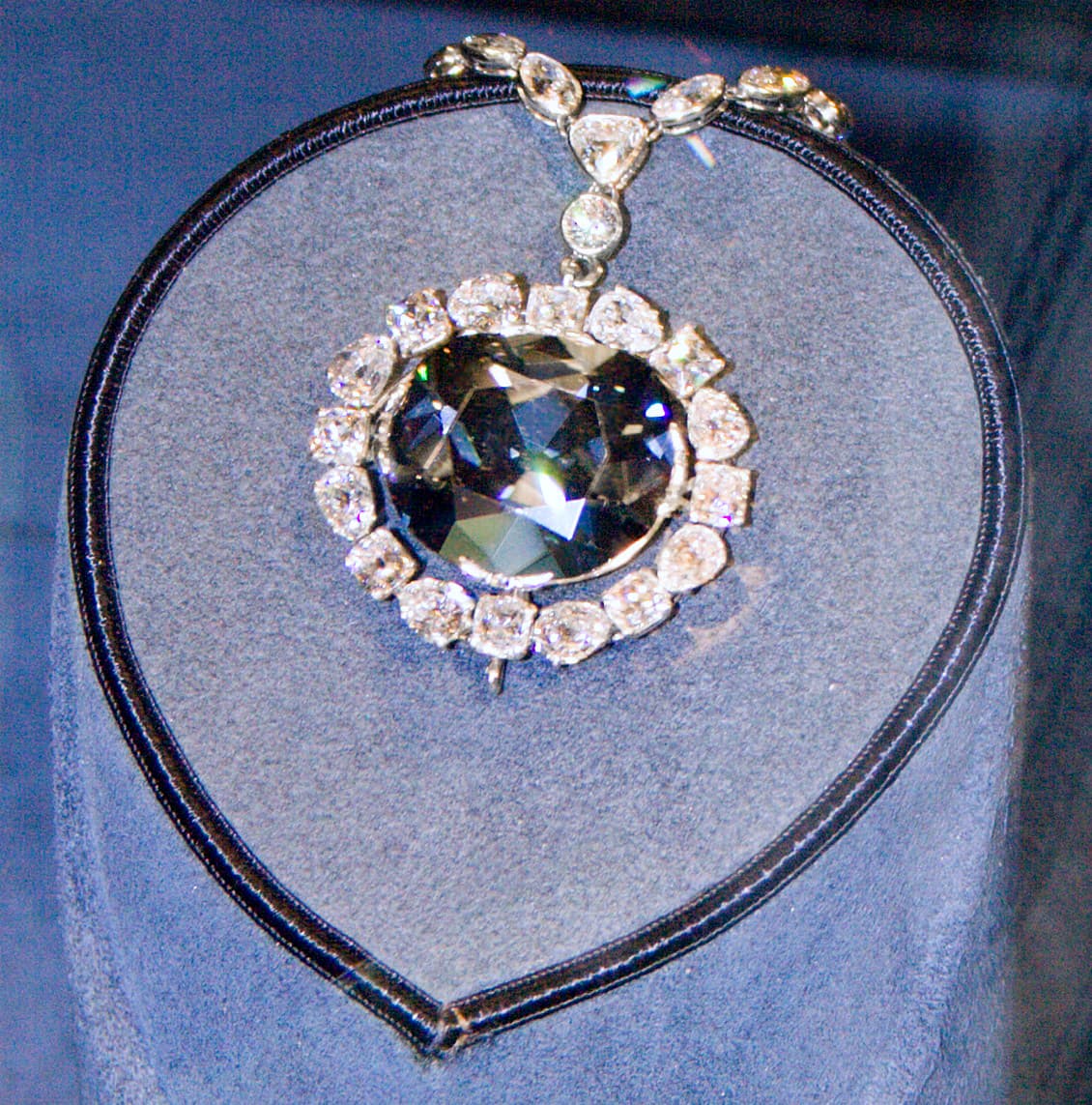
The Hope Diamond is a diamond extracted in the 17th century from the Kollur Mine in Guntur, India. It is blue in color due to trace amounts of boron. Its exceptional size has revealed new information about the formation of diamonds. The stone is one of the Golconda diamonds. The earliest records of the diamond show that French gem merchant Jean-Baptiste Tavernier purchased it in 1666 as the Tavernier Blue. The stone was cut and renamed the French Blue (Le bleu de France); Tavernier sold the stone to King Louis XIV of France in 1668. It was stolen in 1792 and re-cut, with the largest section of the diamond appearing under the Hope name in an 1839 gem catalogue from the Hope banking family. The diamond has had several owners, including Washington socialite Evalyn Walsh McLean, who was often seen wearing it. New York gem merchant Harry Winston purchased the diamond in 1949, touring it for several years before donating it in 1958 to the Smithsonian National Museum of Natural History in the United States, where it is on permanent exhibition. The Hope Diamond, also known as Le Bijou du Roi ("the King's Jewel"), Le bleu de France ("the French Blue"), and the Tavernier Blue, is a large, , deep-blue diamond, studded in a pendant Toison d ’or. It is currently housed in the National Gem and Mineral collection at the National Museum of Natural History in Washington, D.C. It is blue under ordinary light because of trace amounts of boron within its crystal structure, and exhibits a red phosphorescence under exposure to ultraviolet light. It is classified as a type IIb diamond. The Hope Diamond has changed hands numerous times on its way from Hyderabad, India, to France, Great Britain, and the United States, where it is on public display. It has been described as the "most famous diamond in the world". Weight: In December 1988, the Gemological Institute of America's laboratory determined the diamond to weigh . Size and shape: The diamond has been compared in size and shape to a pigeon egg or a walnut that is pear-shaped.